
In the year gone by, Indian Space Research Organisation achieved self-reliance in launch vehicle technology with the successful ground testing of the Cryogenic Upper Stage, a key component in putting heavier payloads in orbit.
On the positive side, if India indeed decides to go ahead with the manned mission, it would give a tremendous impetus to the development of many new technologies, including relating to life-supporting ones.
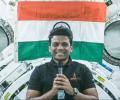
Group Captain Shubhanshu Shukla, the first Indian to visit the International Space Station, has been awarded the Ashoka Chakra, India's highest peacetime gallantry award. The award recognizes his contributions to the Axiom-4 mission and India's advancements in human space exploration.

The British-built Strand-1 spacecraft, developed by scientists in Surrey, was sent into orbit from Sriharikota in India to test the capabilities of many standard smartphone components for a space environment.
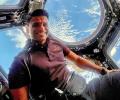
Shubhanshu Shukla's first seven days in space have combined science, ceremony, and moments of levity.

The National Testing Agency (NTA) has informed the Supreme Court that the NEET-UG exam will transition to a computer-based test (CBT) mode from next year, following consultations with the Centre and recommendations from a high-level committee.

Indian astronaut Shubhanshu Shukla, currently on the ISS as part of the Axiom-4 mission, has acknowledged ISRO's efforts in ensuring his safe travel. He spoke with ISRO chairman V Narayanan about his well-being and the experiments being conducted on the ISS.
India and the US have agreed to cooperate in the exploration and use of space for peaceful purposes, including in human space flight, under an agreement signed between their space agencies.

The move follows a quiet visit by National Security Advisor Ajit Kumar Doval to the Vikram Sarabhai Space Centre in Thiruvananthapuram.

ISRO has announced plans for seven launch missions by March, including the first uncrewed mission for the Gaganyaan project and demonstrations of new satellite technologies.
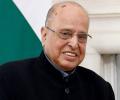
K Kasturirangan, former chairman of the Indian Space Research Organisation (ISRO), passed away at the age of 84 in Bengaluru on Friday. He was suffering from age-related ailments for the past few months. Kasturirangan, who also served as the chairperson of the drafting committee on the New National Education Policy (NEP), was a renowned space scientist and had a distinguished career spanning several decades. He was known for his contributions to ISRO's successful space programs and his role in shaping India's education policy.
This mission, tentatively scheduled for 2013, will be the precursor to Indian Space Research Organisation's maiden human spaceflight planned to be launched in 2015. India and Russia signed a Memorandum of Understanding on Joint Activities in the Field of Human Spaceflight Programme during the recent visit of Russian President Dmitry Medvedev.

From a surge in startups to crewed mission preparations, 2025 marks a transformative year as India eyes $44 billion space economy by 2033.

ISRO has released the footage of the injection of PSLV-37 which launched a record 104 nano-satellites overseas customers into the orbit in blocks in a series of separations.
India will not undertake a human space flight before the year 2017 and is likely to use a next-generation rocket for the ambitious mission, the cost of which would be reworked, Chairman of Indian Space Research Organisation, K Radhakrishnan said on Monday.
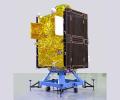
The need for NavIC was cemented after India was denied access to crucial navigation data from global providers during the 1999 Kargil War.

The mission was originally scheduled for lift-off on May 29 but was put off multiple times when engineers detected a liquid oxygen leak in the boosters of the Falcon-9 rocket and NASA also detected leaks in the ageing Russian module of the ISS.
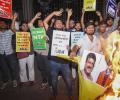
The Supreme Court on Monday said it was sad that National Testing Agency has not learn lessons from the earlier NEET paper leak as it sought response from the Centre, NTA and Central Bureau of Investigation on pleas for replacement of the testing agency with a robust and autonomous body to conduct the medical entrance exam.
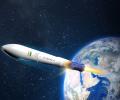
The Vikram-I rocket will fly with its maximum carrying capacity and put the satellites in a Low Earth Orbit.
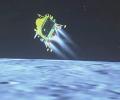
Despite the chill in bilateral ties, Pakistan's media on Thursday gave front-page coverage to India's historic moon landing while a former minister even called it a 'great moment' for Indian Space Research Organisation.

The Human-rated LVM3 vehicle, the Crew Escape System and the Crew Module and Service Module are all in final stages of testing and integration.
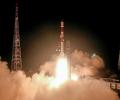
The two Space Docking Experiment (SpaDeX) satellites that the Indian Space Research Organisation is hoping to unite are at a distance of 1.5 km and will be brought much closer on January 11, the space agency said on Friday.
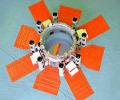
The Indian Space Research Organisation will open 2025 scoring a century orbiting the country's navigation satellite 2,250 kg NVS-02 with its rocket Geosynchronous Satellite Launch Vehicle (GSLV)-F15.
Waking up to the threat posed by China acquiring capability to shoot down satellites by missiles, India on Tuesday announced setting up of an integrated space cell to counter growing threats to the country's space-based assets.
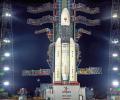
Finance Minister Nirmala Sitharaman on Saturday announced giving the private sector a role in India's space programme, including in satellites, launches and space-based services.

The satellite, weighing about 4,410 kg will be the heaviest to be launched from the Indian soil and into a Geosynchronous Transfer Orbit (GTO), the space agency said. The satellite will travel onboard a LVM3-M5 rocket, dubbed as 'Bahubali' for its heavylift capability.

"If we have to ensure the safety of our country, we have to serve through our satellites. We have to monitor our 7,000 km seashore. We have to monitor the entire northern part continuously. Without satellite and drone technology, we can't achieve that."

Restoring weighted tax deductions and adopting a petty patents regime can foster firm-level innovative activity critical for competitiveness, points out Nagesh Kumar.

The ISRO chief further said that the ISRO is ready to fulfill the vision put forth by Prime Minister Narendra Modi.

'This may open up doors for private players in India to collaborate with global players in commercial missions.'

The Indian Space Research Organisation (Isro) on Thursday came out with the Indian Space Policy 2023 to promote greater private sector participation in the entire value chain of the space economy. According to the policy, Isro will encourage new-generation entities to participate in space exploration and human presence in outer space, including collaboration with domestic and international stakeholders. The policy also sets a road map for Isro to transition from manufacturing operational space systems to focus energies on research and development in advanced technologies.

The Indian Space Research Organisation on Wednesday placed in orbit seven satellites including Oceansat-2 within a span of 20 minutes, its first successful mission after the abrupt end of the ambitious Chandrayaan-I project.
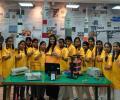
If it becomes a reality, the Chennai-based company will become the first private player from India to conduct such a mission to the lunar surface.
The successful landing of the Moon Impact Probe on the lunar surface has not only boosted the confidence of ISRO to undertake inter-planetary travel in future, but also conveyed a firm message to the world that India means business in the field of space, ISRO chief G Madhavan Nair said in Bengaluru on Friday.

'With India's growing capabilities in the space sector, this creates promising opportunities for enhanced collaboration and market access.'

ISRO stated that the disengagement of at least one contact -- in both the main and redundant paths -- of a connector led to the failure of NVS-02.
The T-52 hour countdown for the launch of the PSLV-C7 began at 0548 hours on Monday, and it was progessing smoothly.

Group Captain Shubhanshu Shukla Shukla says Wing Commander Rakesh Sharma -- the first Indian to travel to space --has been advising him about the space flight.
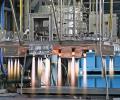
With these successful tests, ISRO has moved a step closer to India's first human spaceflight mission, Gaganyaan.
"We will have to study newer technologies to develop capsules, which will send men to space and bring them back safely"
